Tanks and Rods: Moving Dive and Fishing Gear by Golf Cart
Tanks and Rods: Moving Dive and Fishing Gear by Golf Cart
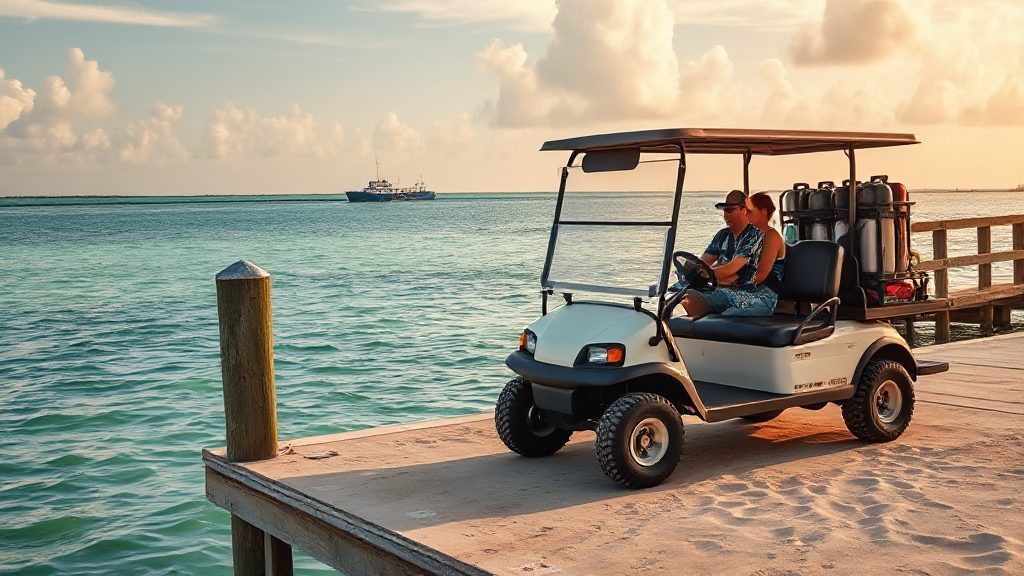
You are standing on the sandy edge of a dock in San Pedro with a tank bag over one shoulder, two rod tubes under your arm, and a mask crate at your feet. A small golf cart is idling nearby. The question is not whether it will fit — it is how to load it so nothing gets scratched, bent, or left behind. This is the practical reality of an Ambergris caye golf cart rental when your trip revolves around equipment rather than beach towels.
The short answer: with a few deliberate choices about how you stack, strap, and secure gear, a standard cart handles a full dive or fishing load without drama. Below is a gear-by-gear walkthrough, a loading sequence that actually works, and a security note for the hours when your equipment sits in the cart while you are in the water or at lunch.
Gear-by-Gear: What Fits Where on the Cart
Not every piece of equipment behaves the same way in motion. Tanks are heavy and roll; rods are long and fragile; masks and regulators are small and expensive. Treat each category differently and the loading job becomes simple.
Scuba tanks and tank bags
A single aluminum 80 tank weighs roughly 30 pounds when full, and a tank bag holding two of them becomes the heaviest item on the cart. Place tanks low and centered — on the floorboard between the front seats or in the rear cargo bed directly over the axle. Never stand tanks upright and unsecured on a seat; a sudden stop turns them into projectiles. If you are renting a 4-seater, one tank bag on the floorboard is usually the limit before legroom disappears.
Lay tanks horizontally if your bag allows it, valves pointing toward the center of the cart. That keeps the heaviest mass from shifting sideways on turns. If you must carry them upright, wedge the bag against the seat frame and run a strap through the bag handle.
Rod tubes and assembled rods
Fishing rods are the most fragile cargo on any island cart. A 7-foot rod tube does not fit neatly across a cart seat, so plan the angle before you load. The safest position is diagonally along the rear cargo bed with the tip end forward and slightly elevated, so the tube cannot slide out under braking. If your cart has a roof frame, a light bungee from the tube to the frame stops it from rolling.
Break down two-piece rods and store them in tubes rather than carrying them assembled. Assembled rods catch wind, snag on passing branches, and are the first thing to snap when a cart turns sharply.
Regulators, masks, and electronics
Regulators and dive computers should never ride loose in an open cargo bed. Salt spray, dust from unpaved roads, and direct sun all shorten their life. Pack them in a padded bag and keep that bag in the footwell or under the front seat, where it is shaded and cushioned. Masks go in a hard case; a cracked lens on day one ruins the week.
Phones, cameras, and chargers belong in a dry bag that stays with you, not in the cart, when you leave it parked.
Weights, fins, and the odds and ends
Weight belts and lead pouches are dense and small, which makes them easy to lose and easy to overload one corner of the cart. Distribute them in a single gear crate rather than scattering them. Fins stack flat and make a good base layer in the cargo bed. Save the last corner of the cart for a mesh bag holding sunscreen, towels, and water — the items you will reach for constantly.
A Loading Sequence That Keeps Gear Safe
Order matters more than strength. Load heavy, low, and centered first, then build upward and outward. This sequence works for both dive days and fishing mornings.
- Park on flat ground and set the brake. Loading on a slope invites a rolling cart and a dropped tank.
- Place the tank bag or heaviest crate first, on the floorboard or directly over the rear axle.
- Lay rod tubes diagonally along the cargo bed, tips forward, and bungee them to the frame.
- Stack fins and soft bags around the base of the heavy items so nothing can shift into open space.
- Put regulators, masks, and electronics in the shaded footwell or under the seat in padded cases.
- Do a shake test. Push the cart gently side to side; if anything rocks or slides, re-strap before you drive.
One more habit: keep a small dry bag with a spare strap and two bungees in the cart at all times. Straps fail, and a five-dollar bungee saves a rod tube. If you are weighing cart sizes for a group with multiple tank bags, the difference between a 4-seater and a 6-seater matters more than the price — a San Pedro Belize golf cart rental with a larger rear bed gives every bag its own corner instead of a pile.
Driving With a Loaded Cart: What Changes
A cart carrying tanks and rods does not handle like an empty one. Acceleration is slower, braking distances stretch, and turns feel top-heavy. On San Pedro’s sandy roads and the bridge crossings, that difference is worth respecting.
Drive slower than you think you need to, especially over speed bumps and unpaved stretches where vibration travels straight into rod tips and regulator threads. Take corners wide and gently. Avoid piling bags above the height of the seat back, because a tall load blocks your rear view and shifts the cart’s center of gravity. If your rental includes unlimited bridge passes, cross at a steady low speed rather than accelerating up the ramp.
Plan your route around your gear, not just your itinerary. A dive shop, then the marina, then lunch means the cart sits loaded for hours. Group stops so the heaviest items come off first at the end of the day, and never leave tanks standing loose while you run into a shop.
For groups mixing divers and anglers, a 6-seater gives you room to separate wet gear from dry gear — a small thing that prevents a soaked rod bag and a corroded reel. Comparing options is easier when you know the daily rate and what is included; a Golf cart rental San Pedro Belize quote that includes delivery and support is often the better value than a cheaper cart with hidden extras.
Security: Leaving Gear in the Cart Between Dives
The hardest part of gear logistics is not loading — it is walking away. Between a morning dive and an afternoon run, your equipment may sit in a parked cart for an hour or more. Treat that window as a real risk, not an afterthought.
Never leave regulators, dive computers, cameras, or reels visible in an open cart. Lock small valuables in the accommodation safe or carry them. For larger items, park where you can see the cart, or choose a lot with staff on site. A simple cable lock threaded through tank bag handles and the cart frame deters casual theft and, just as importantly, stops gear from walking off when someone borrows the cart.
Cover what you cannot lock. A plain towel or gear blanket over a tank bag hides the shape and removes the invitation. At the end of the day, rinse tanks and rods with fresh water before storage — salt left on gear overnight is the quiet cause of most equipment failures.
If you are renting for a full week of diving and fishing, ask about support before you book. A San Pedro golf cart rental with 24/7 roadside help means a flat tire on the way to a dawn dive does not end your morning. And if budget is the deciding factor, a Cheapest golf cart rental San Pedro Belize option still gets your tanks and rods from dock to reef — as long as you load them with the same care.
The Short Version
Heavy and low first, long and strapped second, small and padded last. Drive slower with a load, cross the bridge gently, and never leave valuables visible in a parked cart. Do those things and the tank bag that looked impossible at the dock becomes a ten-minute loading job — leaving you more time for the water and less time worrying about your gear.